The Whistle
Draft
Part 2 of a series on the NBA’s fading home-court advantage; start with Home Court Advantage Is Fading.
For at least forty years the home team in the NBA got the friendlier whistle, and almost nobody worked a playoff game any other way. Of the 47 officials with at least 50 playoff games on record, 45 called fewer fouls on the home team. Then the whistle mostly evened out. The home foul advantage in the regular season fell from about 1.2 fouls a game in the 1980s to roughly a quarter of a foul today, an 80% reduction; in the playoffs it dropped from about 1.6 to 0.7. Here is how it worked, why it faded, and why an edge this small was ever able to matter.
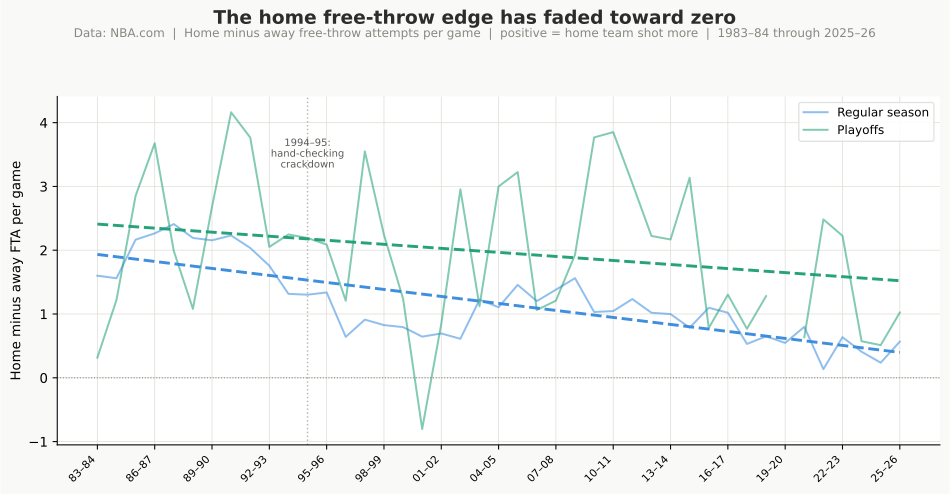
The whistle used to give the edge to home, everywhere
In every decade, and in both the regular season and the playoffs, referees have called fewer fouls on home teams. In the 1980s and early 1990s, home teams averaged about 1.2 fewer foul calls per game in the regular season, worth roughly 2 extra free throw attempts a night. In the playoffs the edge was wider: about 1.6 fewer fouls and 2.4 more free throws. With fouls go free throws, and with free throws go points. Of the four ways home teams have historically come out ahead (better shooting, more rebounds, fewer turnovers, and the whistle), this is the most consistent.
Then it mostly evened out
The drop, in free-throw terms: home teams once attempted about 2 more free throws per game than visitors; now it is just under half a free throw. The playoffs moved the same way but less: the foul gap fell from 1.6 to about 0.7, the free-throw advantage from 2.4 to 1.1 attempts, the postseason lagging behind as it does on every part of this story.
Two different changes drive the decline for fouls. Three-point attempts draw fewer fouls than drives to the basket, so as both teams moved to the perimeter there were simply fewer foul calls to go around, and the home team’s absolute gap shrank with them. About half of the foul decline traces to that shift in shot selection; The Three-Point Suspect makes the full case that the move to the arc reaches close to half of the whole decline. The other half of the foul story is genuine change in how referees call the game.
And that change reads as a generational one, or it could be that the league has successfully trained referees to be more fair. Referees are now not only less biased on average; they are also more uniform in their calling. The spread across officials has compressed, so a game today is called much the same whoever has the whistle.
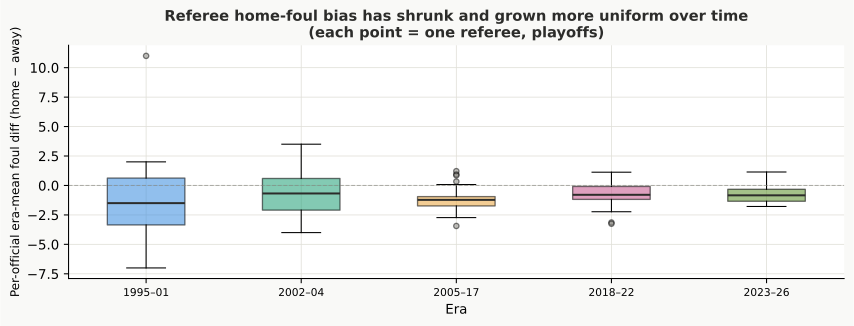
Per-official records only begin in 1995, so the 1980s and early-1990s baselines above come from the overall foul gap, not from individual referees.
How a two-attempt advantage ever mattered
In the 1980s the home team attempted about 2 more free throws a game than the visitor, worth a bit over a point of scoring. That is a tiny number to decide anything.
On any single night, it can’t. Free-throw attempts swing wildly from game to game (foul trouble, a hack-a-shaq stretch, a night both teams live at the line), so the average edge toward the home team is nowhere near the biggest thing moving the count in any one game. In the 1980s, the middle 80% of regular-season games saw the home team attempt anywhere from -12 to +16 more free throws than the visitor, a range many times the width of the +1.97-attempt average sitting inside it. A game where the home team shot 10 fewer free throws than the visitor is well inside that ordinary range and says nothing about who the referees favored that night.
| Average | Typical range* | |
|---|---|---|
| Regular season, 1984–94 | +1.97 | -12 to +16 |
| Regular season, 2023–26 | +0.46 | -11 to +12 |
| Playoffs, 1984–94 | +2.35 | -11 to +16 |
| Playoffs, 2023–26 | +1.09 | -10 to +11 |
Typical range: excludes the most extreme 10% of games on each end, so it covers the middle 80% of nights.
The average shrank far faster than the swing around it. In the regular season, the average free-throw advantage fell 77% while the typical night-to-night range narrowed by only 18%. The share of games where the home team attempted more free throws than the visitor fell from 56% to 49%, close to a coin flip. The playoffs show the same shape but move less: the average fell 54%, and the home-favored share only slipped from 57% to 56%, another sign the playoffs lag the regular season.
The foul count behind those free throws tells the identical story.
| Average | Typical range* | |
|---|---|---|
| Regular season, 1984–94 | -1.23 | -8 to +6 |
| Regular season, 2023–26 | -0.25 | -6 to +6 |
| Playoffs, 1984–94 | -1.58 | -8 to +5 |
| Playoffs, 2023–26 | -0.68 | -6 to +5 |
The regular-season foul gap fell 80% while its night-to-night range narrowed only 14%; the playoff foul gap fell 57%, again a smaller drop than the regular season.
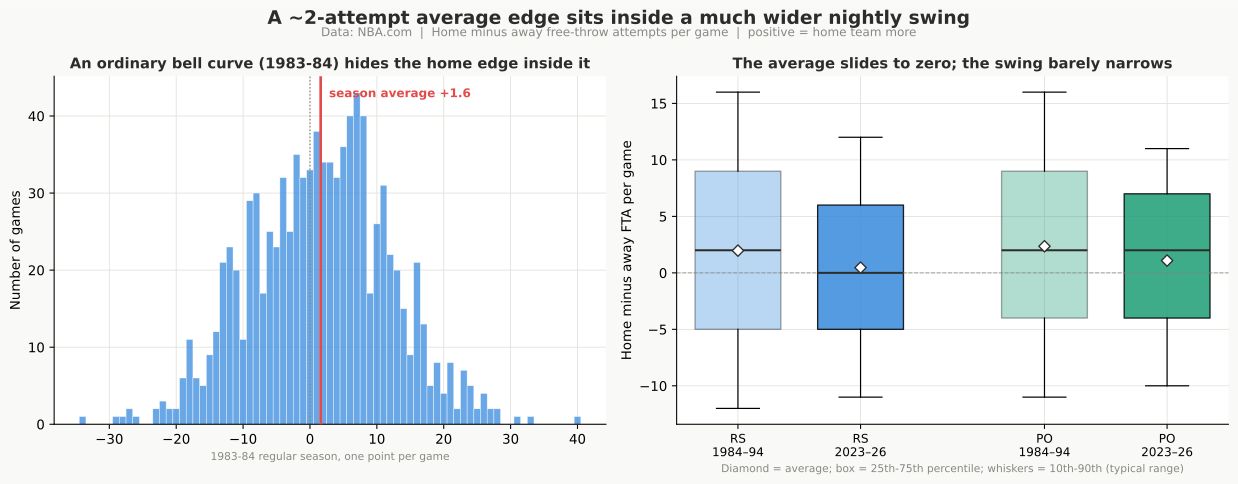
Here is why an edge that small still tilts games. Split any night’s free-throw gap into two parts: a small piece that leans home in every game, and a large random piece that swings either way. Stack a season together and the random piece cancels, half the nights it helped the home team and half it hurt, while the small edge keeps pointing the same direction and adds up. That surviving edge is worth about a point of scoring, and a point is enough, not because most games are close, but because it never has to touch the blowouts. Most games aren’t close: the typical one is decided by about ten points, and a rout stays a rout whether or not the home team shot two extra free throws. Nudge every game’s scoring margin up by that point and the routs are undisturbed; the only games that flip are the ones already a possession from going either way. Those are a minority, but there are enough of them: because a game’s final margin swings by a dozen points or more from night to night, one point of scoring margin is too little to see in any single box score, yet enough to bend a whole season’s win rate once every game is stacked up.
So the whistle’s edge was never something you could point to in a single box score. It only appears once thousands of games are stacked together, and it has faded further than the night-to-night swing ever has.
The referees themselves
Are some referees more unfair than others? Yes, but by less than a raw leaderboard suggests. Of 47 officials with at least 50 playoff games, 45 call fewer fouls on the home team. The most home-leaning on record, Ron Garretson (last worked a playoff game in 2017-18), Joe Crawford (2014-15), and Eddie Rush (2011-12), sit roughly a full foul per game apart from the most even-handed, a group that includes Tony Brothers, Josh Tiven, and Joe Forte. About 60% of that raw spread, though, is the random bounce of how few games some officials worked. Referees genuinely differ, and the gap between them is narrower than the leaderboard suggests. This measures tendencies, not proof that any one official decides games.
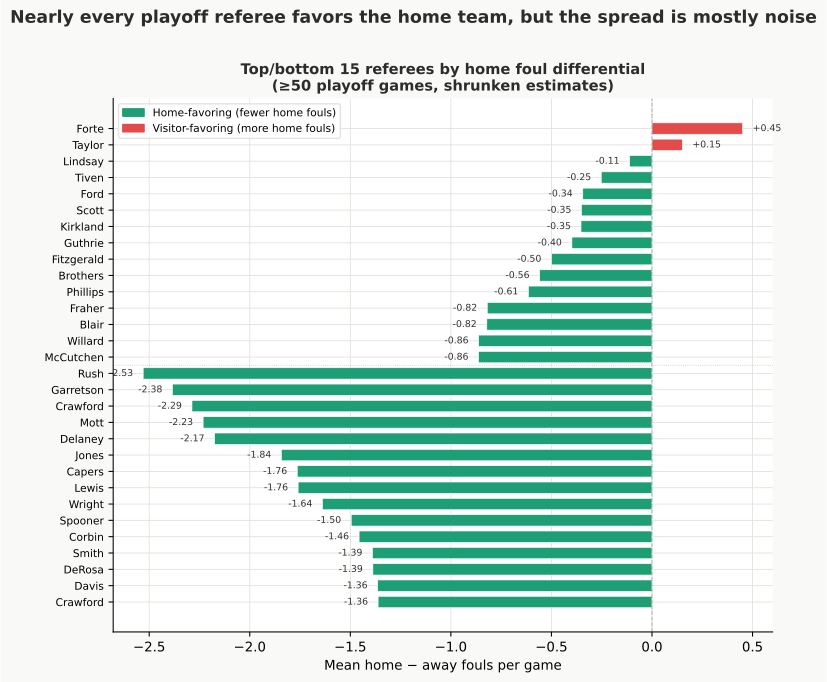
The whistle is the cleanest-cut piece of the home-court story: a real, repeatable bias that nearly every referee shared, that faded for two reasons I can name, and that was always too small to see on any single night. How much of the decline the move to three-point shooting really carries, foul calls included, is the next piece.
Next: The Three-Point Suspect. It’s the obvious culprit, and the 40-year chart looks damning; how much of the case it actually closes is smaller than the chart suggests.
Back to the series hub: The Disappearing Home-Court Advantage
How this was made: the writing here is mostly AI/LLMs working from my analysis and direction; the numbers are all Python on public NBA data. The full note is on the series hub.