Did the 2026 Knicks Have a Historic Playoff Run? The Short Version
Draft
The Knicks’ own regular season gave them a 15% chance to win the title. They won it, and in 43 years of NBA champions none has outscored its playoff opponents by more.
The only real question is whether that dominance is as real as it looks, or a mirage thrown up by a weak field. Mostly the former. The obvious knocks against a 16-3 run don’t land, and the Knicks earned the title the hard way: they saved their toughest opponent for last and beat it anyway. The one thing that genuinely tempers the claim is the shortness of any playoff run, not a weakness in who they beat.
1. The dominance is real
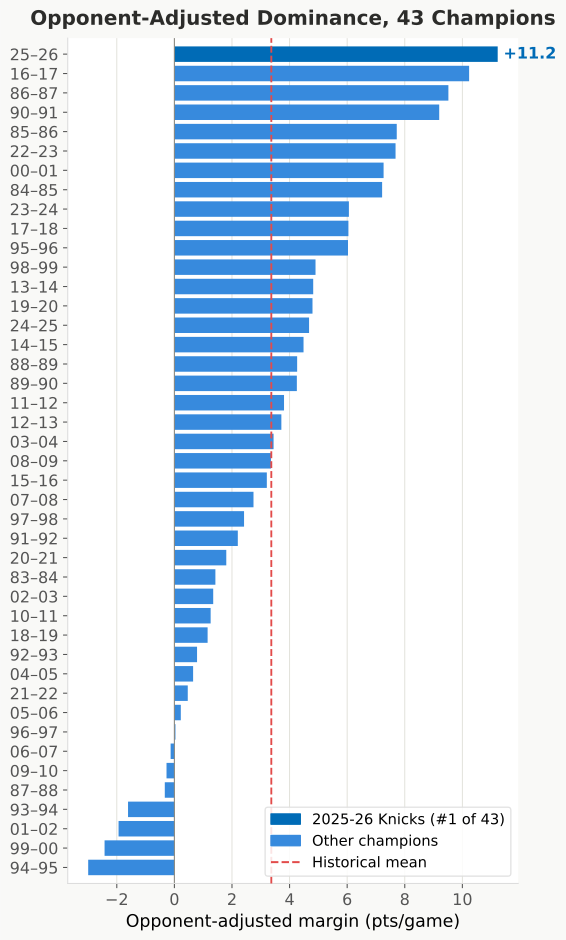
The Knicks outscored their playoff opponents by +14.9 points a game, the highest raw margin in 43 years. Adjust for how good those opponents were and the margin of +11.2 still ranks first, ahead of the 2016–17 Warriors (+10.2) and 1986–87 Lakers (+9.5).
The four knocks a skeptic reaches for, and what the data says:
| The knock | Does it hold? |
|---|---|
| The East was weak | No. The West–East strength gap was only +0.39 points a game; the West led by more in 63% of seasons since 1984. |
| The bracket was soft | No. The Knicks’ opponents rated +3.67 on average (season-long scoring margin, adjusted for schedule), right at the median champion’s schedule. |
| The margins were padded by blowouts | No. On a wins-only rating that never sees a point margin, the Knicks still rank first of 43. |
| The opponents were hurt | Barely. All four opponents suited up 98% of their rotation (the Spurs and Hawks at 100%), though that can’t see who played hurt, as the Spurs’ Fox did. |
2. They earned it the hard way
A 16-3 record could mean a coast against soft opponents. It was closer to the opposite: the Knicks saved their hardest test for last and passed it.
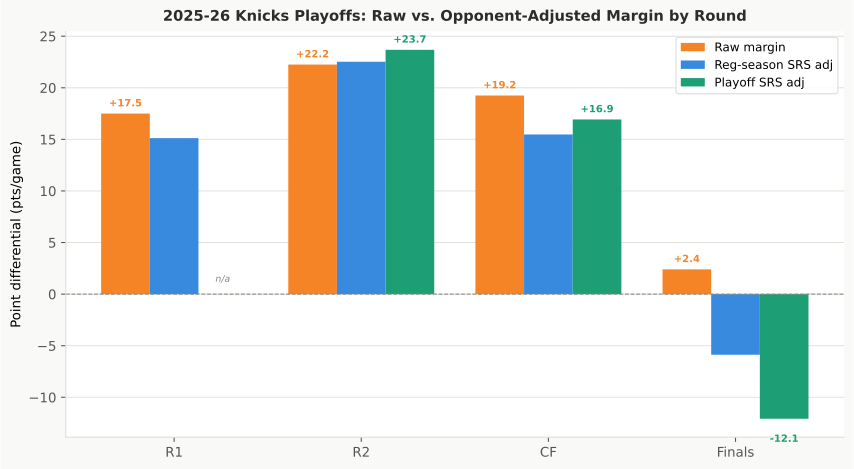
Against the East (Hawks, 76ers, Cavaliers) they went 12-2 and won by +19.4 points a game across 14 games. Against the Spurs in the Finals they won 4-1 by an average of just +2.4 points, with 4 of the 5 games decided by 4 points or fewer.
That gap is not just about opponent quality. The two teams that improved most from the regular season met for the title. The Knicks made the biggest playoff jump of any team in the 2026 field (a rise of +11.5 points, the 2nd-biggest any champion has produced), and the Spurs were second, climbing from a regular-season rating of +8.28 to +15.13 in the playoffs (+14.48 against teams other than the Knicks). So the Finals were tight because the Knicks beat the best-performing team they faced, not a fading one.
3. The one caveat that survives
Nineteen playoff games is a small sample, and that shortness is the one real limit on the #1 claim.
Re-draw those 19 games at random and the Knicks still finish first about 60% of the time. Put every past champion under that same uncertainty, letting each one be as lucky or unlucky as the Knicks, and their chance of being the single best ever settles at about 9% (roughly a third to land in the top five). It is the best raw number any champion has posted and one of the best handful of runs ever, but not provably the single best.
The bottom line
A 15% longshot delivered a run that sits at the top of NBA history by every adjusted measure tested. The schedule was average, the opponents were available, and the East was competitive. The toughest team they faced pushed them to the final possessions of a 4-1 Finals. New York won it anyway.
Appendix: Companion Documents
| Document | Description |
|---|---|
| Full Report | Complete findings with all charts and section-by-section analysis. |
| Stats Explainer | Guide to the statistical methods, written for a reader who knows some statistics. |