NBA Player Rating Systems: Summary
Draft
Among the ratings that never use who won, the one that best describes a finished NBA season is one of the worst at predicting the next: in a typical season among the 30 tested, PER rebuilds about 68% of the gaps between teams in a season just played but forecasts the next at only about 10%. That is one thread of a larger problem: there is no single best way to rate NBA players, and the systems disagree in ways that matter for players on losing teams, defensive specialists, and high-usage scorers.
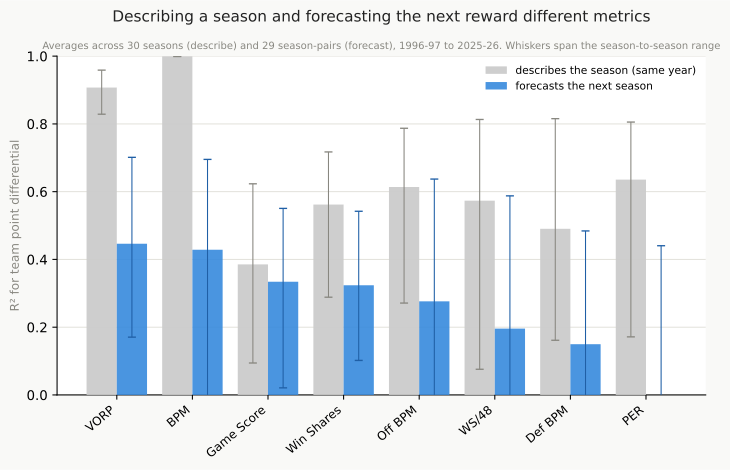
This report recomputes the box-score systems for 2025-26, adds a from-scratch RAPM built from a full season of play-by-play, and puts three questions to them:
- Do the systems agree?
- What does each system uniquely capture?
- How should they be combined into one rating?
Do they agree? At the top, closely; below it, less than their reputations suggest. The same handful of players (Nikola Jokić, Shai Gilgeous-Alexander, Victor Wembanyama) rise to the top of nearly every system and of both combined ratings. Below the top tier they part: Win Shares favors efficient big men on good teams (Amen Thompson) while PER rewards high-usage scorers (Giannis Antetokounmpo), so the same player can sit many spots apart. The from-scratch RAPM, built only from which lineups outscored their opponents, only loosely tracks the box scores (about 0.40 on a 0-to-1 scale), which is the point of an impact metric. A reconstruction bug once made that independence look like noise; with it fixed, RAPM+prior, which steadies the noisy lineup data with a box-score estimate, is a usable impact metric, led by the MVP tier (Nikola Jokić, Shai Gilgeous-Alexander, Giannis Antetokounmpo). It is as steady from year to year as BPM, and across the 29 seasons it can be computed it forecasts next-season team results better than any box score.
What does each uniquely capture? It depends. Each system tilts toward a player type, but the all-in-one summaries (PER, Game Score, and the now-validated BPM and VORP) are nearly reconstructable from the others, while Win Shares per minute and the fixed lineup metric carry the most of their own, picking up value the scoring-heavy systems miss. BPM is recomputed and validated against Basketball-Reference here (value agreement 0.93), which makes it accurate but no less redundant; the RAPM family, once a broken recompute, now reads as genuine independent lineup signal after the reconstruction fix, though its absolute values stay approximate.
How should they be combined? Into two ratings that answer different questions. A plain consensus averages every system; a wins-predictive blend weights each by how well it tracked team wins. They agree almost exactly (0.98 on a 0-to-1 scale) on the best players and part mainly on players whose production did not turn into team wins. Beyond those two, a playoff-weighted version of BPM (blending each player’s regular-season and playoff value) follows one more thread the report picked up: Jalen Brunson did raise his game in the postseason (BPM +3.4 to +4.6), which lifts him to 7th of the 103 playoff players, a real step up but short of the top five.
One pattern runs under all three answers: a rank list moves in even steps, but value does not. In VORP, the gap between rank 1 and rank 15 is worth roughly 15.6x as much as the same-sized jump between rank 50 and rank 65, and every system checked shows the same shape to some degree (smallest in WS/48, largest in D-RAPM). Cumulative metrics like Win Shares and VORP pile the most value onto a few elite players, which is why their rank gap at the top runs largest; a ranked list hides all of it.
| System | Rank 1-15 gap vs. rank 50-65 gap |
|---|---|
| D-RAPM | 19.9x |
| VORP | 15.6x |
| Win Shares | 14.1x |
| PER | 11.6x |
| RAPM | 7.3x |
| WS/48 | 3.6x |
The cross-system comparison rests on the 2025-26 season alone, so its exact orderings are a snapshot: year to year the top holds (Nikola Jokić and Shai Gilgeous-Alexander lead both 2024-25 and 2025-26) while the order below it churns. The describe-versus-forecast and stability findings span 30 seasons and are the firmer results.
Full analysis and exact figures are in player_rating_overview_results.md. Methods are in player_rating_overview_stats_explainer.md.