Home Court Advantage Is Fading
Draft
Part 1 of a series on the NBA’s fading home-court advantage.
For most of NBA history, the surest way to beat a better team was to make it come to your building. In the 1980s and 1990s, a weaker team hosting a playoff game won 65% and 66% of those games, about as often as the stronger team won at home. The arena erased the quality gap. Today the weaker team hosting wins about 49%, while the stronger team’s home rate slipped only modestly, from around 70–75% at its peak to about 65%. Home court used to compensate for being outmatched. It no longer does. That is specifically a playoff story: run the same test on the regular season and it moves slightly the other way, a twist covered in full in The Playoffs Are Different (and the Same).
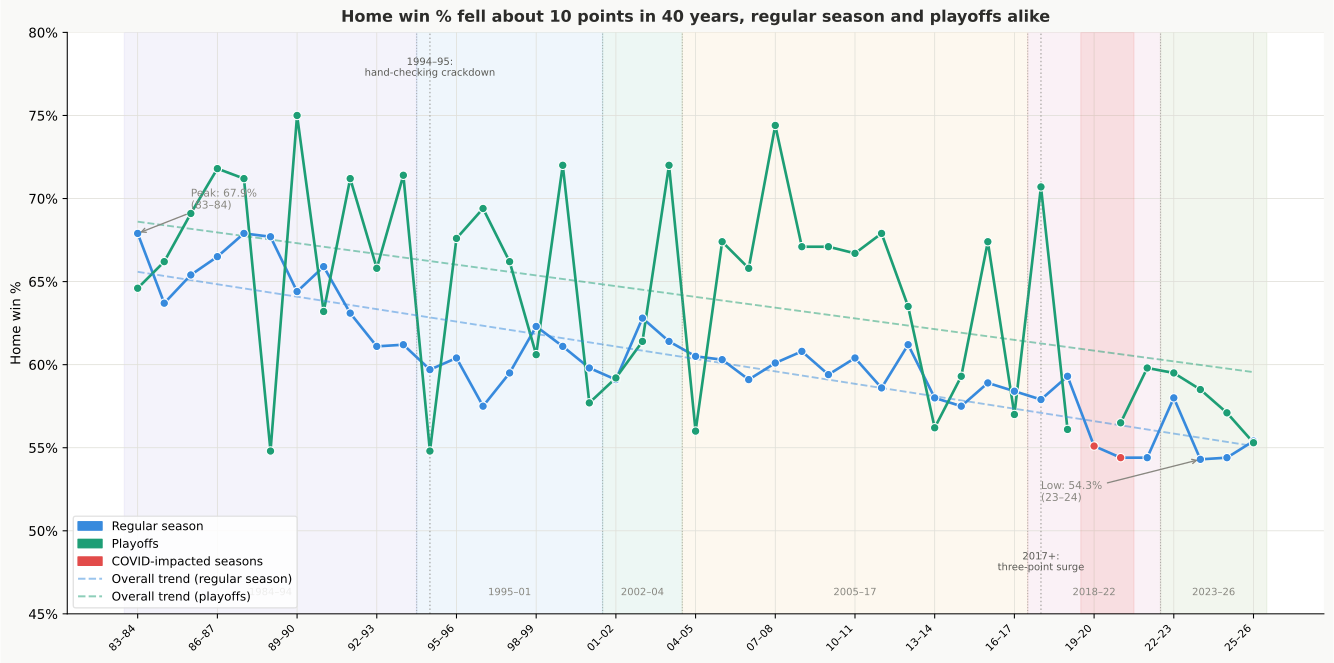
That collapse is one slice of a decline that runs through the whole league, regular season and playoffs alike. The home team’s win rate has fallen from about 65% to 55% in the regular season, and from nearly 68% to 58% in the playoffs. The advantage hasn’t vanished; it is simply worth far less than it was. So this is a whodunit: one victim, home court advantage, and a lineup of suspects. Most turn out to have an alibi, a couple are guilty, and the biggest culprit of all is the one the data can measure but never quite explain. This series is the case file.
Start by settling what most fans walk in assuming:
- Did the rise in three-point shooting play a part? Yes, a big one.
- Was it better travel, or load management? Only a little.
- Was it smaller crowds? No: arenas are as full as ever, even in the seasons home court advantage hit bottom.
Each of those answers has an article behind it. First, the decline itself.
The shape of the fall
The shape of the decline tells you more than the headline number does. Most of the drop is a slow, steady fade of about a quarter of a point per year, which over four decades accounts for nearly the whole thing. Two stretches stand out where the slide briefly sped up, and each one has a real-world event sitting under it.
The first came in the mid-to-late 1990s, when the regular-season rate fell from about 65% to 60%. This is the firmer of the two: the 1994–95 hand-checking crackdown registers as a genuine one-time drop of about 2.6 points, with the rest of that stretch a continued slide as the adjustment played out through the late 1990s. That crackdown changed what referees could let a defender do, which is exactly the sort of change that can land on home and road teams unevenly. A brief uptick around 2002–04 interrupted the slide, though it rests on only three seasons and reads as a wobble rather than a reversal.
The second drop came after 2017, and it is really the three-point revolution showing up on the calendar. The share of shots taken from deep rose from about a quarter to about 40%, and the regular-season rate slid below 56% along with it.
The playoffs followed the same path on a delay. Postseason home court advantage held near 64% from the mid-1990s through 2017, even while the regular season was already sliding, then joined the slide, falling to 61%, then 58%. The two share a shape; the playoffs simply lag behind. Because the regular season runs into the tens of thousands of games and the playoffs into far fewer, the regular-season figures are solid while the playoff ones show the direction of a change more than its precise size.
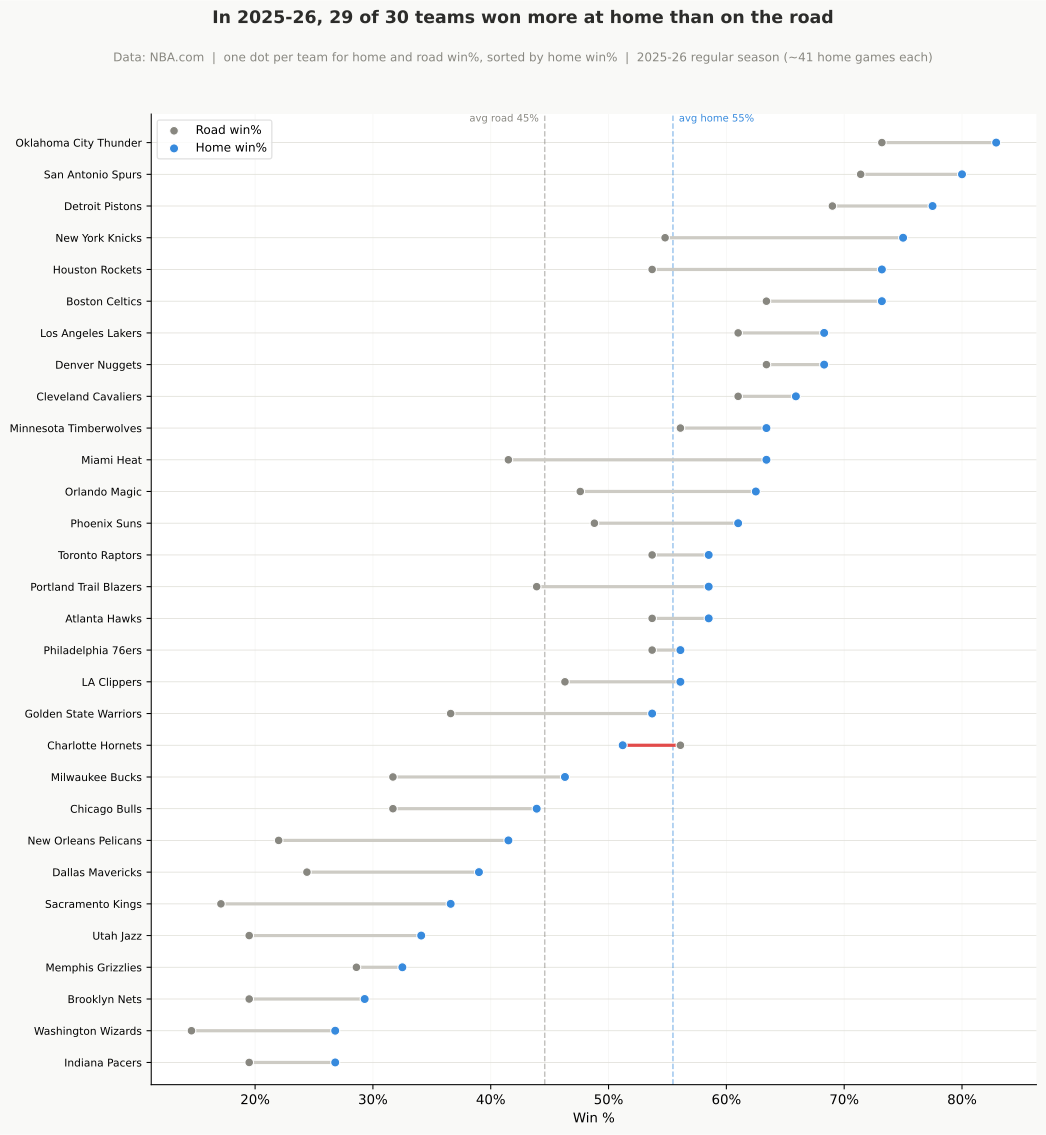
Smaller does not mean gone. In the most recent regular season, nearly every team still won more at home than on the road, with just one exception. Good teams that win everywhere still win a bit more at home; weak teams pick up most of their wins there. The fade is also shared, not the work of a few collapsing franchises: every team’s home advantage slipped at roughly the same league-wide rate.
Where it is heading
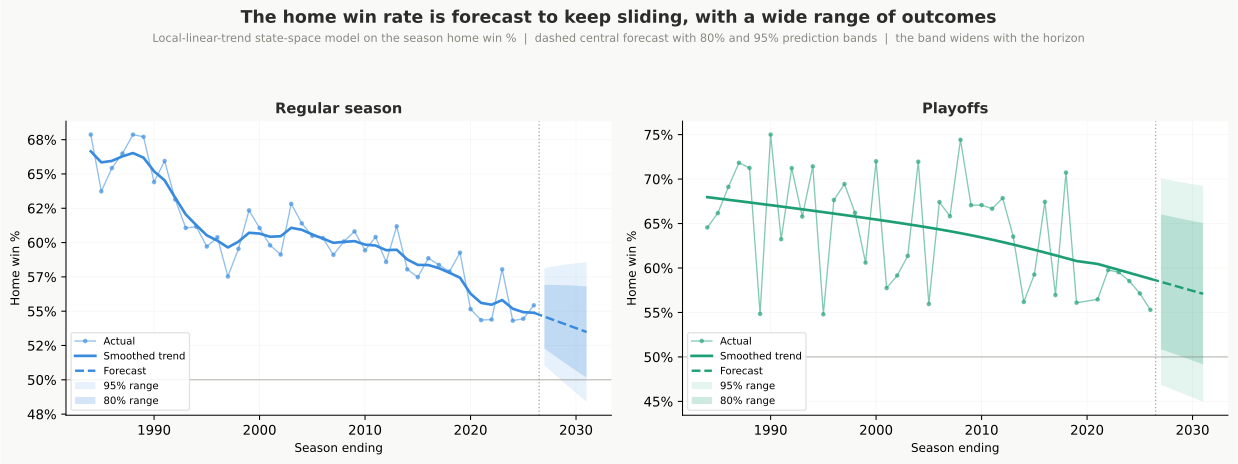
The regular-season rate projects from about 54.9% today to roughly 53.5% by 2031, within a wide range it could plausibly land in, about 48.4% to 58.6%. The playoffs point the same way, from about 58.8% to 57.1%, but on far fewer games the range is much wider, from about 44.9% to 69.3%. This is a straight-line projection of the recent slope, not a forecast that knows about future rule changes or where the decline runs out of room.
There is a floor, though, and the league found it by accident. In the empty arenas of the 2020–21 pandemic season, with no crowd, no friendly whistle, and no home preparation advantage, home teams still won 51%. Something near that is probably where the trend settles rather than at a true coin flip.
What home court advantage is actually made of
Before the case can turn to suspects, it helps to know what is being stolen. Four things decide every possession: a shot falls or it doesn’t, the ball is turned over, a foul sends someone to the line, or a miss is rebounded. Those are the Four Factors, and home teams have historically come out ahead on all four: they shoot a little better, grab more rebounds, commit fewer turnovers, and get the friendlier whistle. Together the four account for about 95% of the home advantage in the regular season, and a similar share in the playoffs. Shooting is the largest piece, more than 40%, followed by rebounding at about 25%, with foul calls and turnover margin making up most of the rest.
Even as home court advantage shrank, how much each factor counts toward winning stayed nearly constant decade to decade. The game got fairer, not different in how its pieces combine. So the question is not what home court advantage is made of now; it is which of those pieces gave way, and why.
The Four Factors tell you where the advantage lands on the stat sheet, not what in the real world produced it. Behind each factor sits a real-world cause: crowd comfort and familiar rims are the usual explanations for the shooting gap, referee tendencies sit behind the foul gap, and rest and travel shape specific matchups. Some of those causes can be measured. Some can only be guessed at, and the data settles only part of it. Rebounding, it turns out, is the largest single driver of the decline, and the one the numbers can measure but not explain: the why is a case of its own, worked in The Mystery on the Glass. That gap between what the numbers show and what they can prove is the tension the rest of the series lives in.
The docket
That is the case, and the rest of the series works it suspect by suspect.
- The whistle. Referees once handed home teams the friendlier call and the extra trips to the line; that gap has mostly closed, and part of the reason is a fairer game. The Whistle works the foul row.
- The three-point boom. As shots moved to the arc, the home shooting advantage flattened, and the shift reaches into the foul and turnover rows too, close to half the decline in all. The Three-Point Suspect asks how far it really reaches.
- The glass. Rebounding is the single largest driver of the decline, and it is the one piece the data can measure but not explain, with a fading turnover gap alongside it. The Mystery on the Glass opens that case.
- The alibis. Travel, time zones, pace of play, crowd size, almost every rule change, and the 2014 playoff format switch: prime suspects that each turn out to have an alibi. The Alibis rules them out one by one.
- The playoffs. The postseason declined too, on its own timeline and its own structure, where a best-of-7 series absorbs most of the advantage. The Playoffs Are Different (and the Same) covers it.
- The buildings. A few arenas still bite hardest, with Denver and Utah at the top, likely because of altitude. The Buildings That Still Bite visits them.
- The proof. Every claim here was run through checks built to make it fail. How I Know This Isn’t Made Up shows the work.
Home court used to be the reward for winning 82 games, the thing that let a worse team stand its ground against a better one. It is fading, unevenly and for reasons that are only partly known, and the pieces of that story are what the rest of this series takes apart.
Next: The Whistle. Nearly every referee who ever worked a playoff game called it a little differently for the home team; the leaderboard names who leaned hardest, and why the edge faded.
Back to the series hub: The Disappearing Home-Court Advantage
How this was made: the writing here is mostly AI/LLMs working from my analysis and direction; the numbers are all Python on public NBA data. The full note is on the series hub.